
Dr. Amelia Gallitano sought out a collaboration in Japan that would explore an unanswered research question
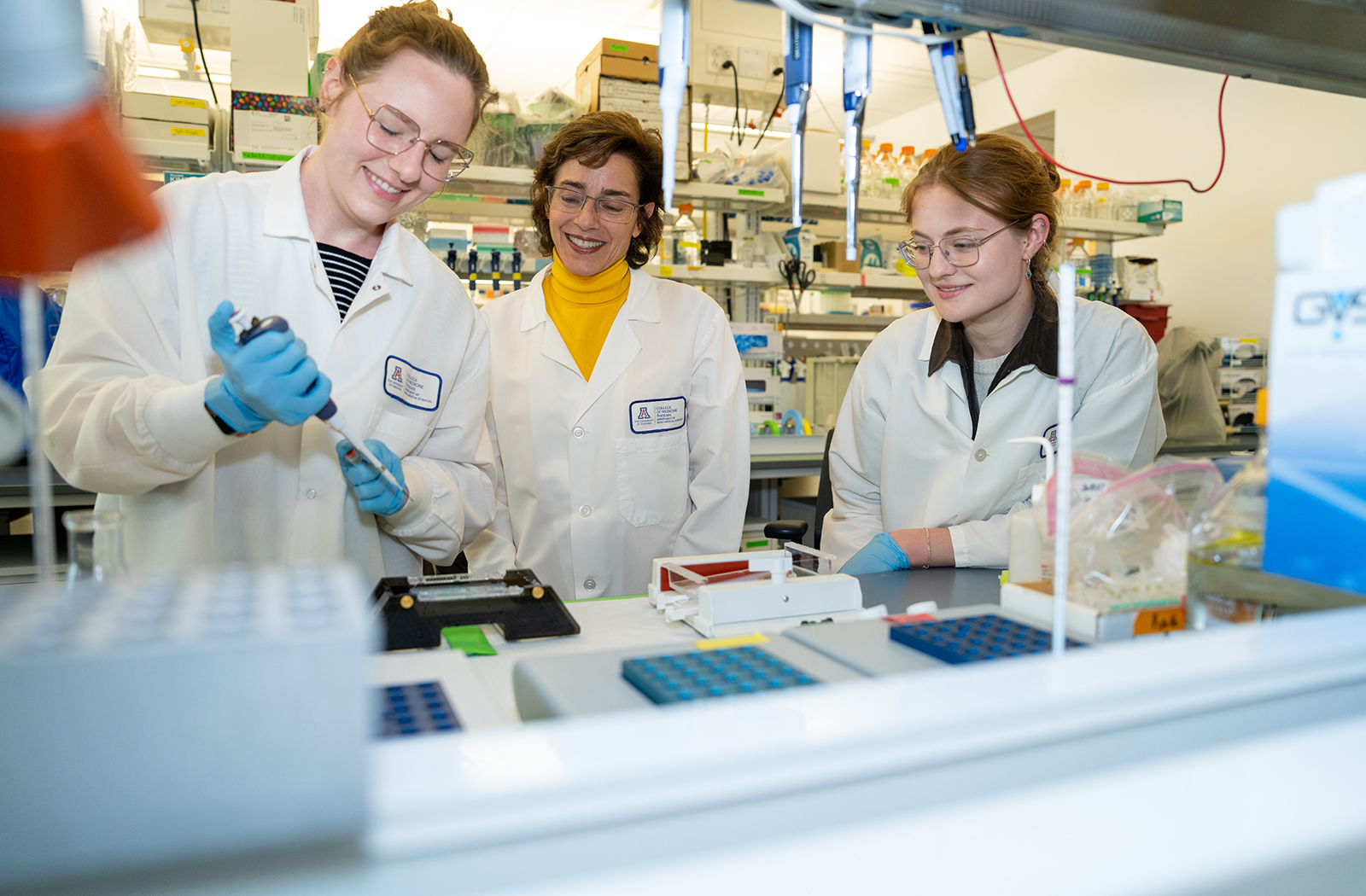
Amelia Gallitano, MD, PhD — seen with Annika Ozols and Sophie Grace Wallace — has long focused on how disruption of certain genes can effect the brain’s functions.
In academia, sabbaticals have been a unique opportunity for tenured researchers to take a step back and pursue research and collaboration about topics of focus and interest.
That adage held true for Amelia Gallitano, MD, PhD, a professor in the Departments of Basic Medical Sciences, Psychiatry and Translational Neurosciences at the University of Arizona College of Medicine – Phoenix. “A sabbatical is a great opportunity to gain a different perspective by being in a different location, surrounded by different people to stimulate new ideas,” she said.
Through a well-earned sabbatical, she was inspired to pursue the answer to a critical research question: If it was possible to selectively increase expression of a gene essential for encoding memory in the right brain cells, and at the correct time, would this improve memory?

Dr. Gallitano’s field of research focuses on memory and mental health disorders. Over the last 25 years, she has been exploring how life experiences interact with genes to affect changes in the brain that may contribute to mental illnesses. Throughout that work, she has found that disruption of certain genes leads to deficits in memory, a core symptom of many psychiatric and neurodegenerative diseases. This then led her to ask whether the opposite could be true. So, they designed the sabbatical study to answer this question.
At the University of Arizona, tenured faculty are eligible to take a sabbatical every seven years; and for Dr. Gallitano — who received grant funding through the Japan Society for the Promotion of Science, enabling the break — the time allowed for cutting-edge research to be conducted and subsequently published in the journal BMC Biology.
The time away from her academic responsibilities served as an opportunity for her to collaborate with Hiroyuki Okuno, PhD, professor in the Department of Biochemistry & Molecular Biology at Kagoshima University, in Japan, who had created a unique tool that allowed her and her team to address their scientific questions.
Dr. Okuno’s tool can turn on higher levels of expression of a gene selectively in cells that are activated in response to an environmental event — the exact catalyst she needed to explore her question.
Because of the COVID-19 pandemic, Dr. Gallitano’s sabbatical was delayed. During this time, her collaborator finished creating the specific construct needed to investigate the Egr1 gene Dr. Gallitano was planning to study. In 2022, she embarked on her leave and traveled to Japan for five months to test the new research tool.
“I was able to test its effect on memory behavior and help understand if there is an improvement in memory,” Dr. Gallitano said. “What we discovered was that if you overexpress our gene selectively in the neurons that are activate when forming a new memory, but at a higher level than normal, you improve memory.”
The implication from this research means this augmentation could help fight against illnesses such as dementia by mitigating memory deficits. Dr. Gallitano hopes that, in the future, this could be translated into protections against symptoms of mental illnesses like schizophrenia, bipolar disorder or depression.
Annika Ozols, an MD/PhD candidate at the U of A College of Medicine – Phoenix and one of the investigators in Dr. Gallitano’s laboratory, said that despite the time difference between Japan and Arizona, research continued to be productive and prolific.
“The transition was good and as a student, I felt supported,” Ozols said. “Dr. Gallitano is very good, in general, in always making time for us.”
In her prior work in Dr. Gallitano’s lab, Ozols said the group has focused on a gene called Egr3, a gene in the same family as the Egr1 gene, which was the focus of the sabbatical project. The difference in this situation, however, is instead of rescuing a deficit, the team was searching to create a positive change.
“It was exciting to me because it was a different perspective on how to approach symptoms,” Ozols said. “I’m always thinking about how these symptoms are presented in humans. I think about the clinical impacts a lot. Taking the results of basic science studies like this and applying them to clinical use is exactly the definition of Translational Research, the focus of my PhD program.”
Sophie Grace Wallace is another student Dr. Gallitano credited with playing a key role in finishing the study. Wallace, an undergraduate researcher who did her Arizona State University honors college thesis in the lab, performed a staining protocol on the model brain tissue — specifically in the hippocampus — in order to analyze changes in the expression of the protein that the gene codes for.
Wallace later presented these findings at the Arizona Alzheimer’s Consortium and the U of A College of Medicine – Phoenix Biomedical Research: Bridging Science and Health Conference and the Arizona College of Emergency Physicians Research Symposium.
“I’m incredibly grateful to Dr. Gallitano for trusting me with this project, and to our outstanding collaborators at Kagoshima University for making this research possible,” Wallace said.
About the College
Founded in 2007, the University of Arizona College of Medicine – Phoenix inspires and trains exemplary physicians, scientists and leaders to advance its core missions in education, research, clinical care and service to communities across Arizona. The college’s strength lies in our collaborations and partnerships with clinical affiliates, community organizations and industry sponsors. With our primary affiliate, Banner Health, we are recognized as the premier academic medical center in Phoenix.
As an anchor institution of the Phoenix Bioscience Core, the college is home to signature research programs in neurosciences, cardiopulmonary diseases, immunology, informatics and metabolism. These focus areas uniquely position us to drive biomedical research and bolster economic development in the region.
As an urban institution with strong roots in rural and tribal health, the college has graduated more than 1,000 physicians and matriculates 130 students each year. Greater than 60% of matriculating students are from Arizona and many continue training at our GME sponsored residency programs, ultimately pursuing local academic and community-based opportunities. While our traditional four-year program continues to thrive, we will launch our recently approved accelerated three-year medical student curriculum with exclusive focus on primary care. This program is designed to further enhance workforce retention needs across Arizona.
The college has embarked on our strategic plan for 2025 to 2030. Learn more.
By: Chase Congleton
University of Arizona College of Medicine Phoenix
SOURCE: https://phoenixmed.arizona.edu/newsroom/news/inspiration-found-during-sabbatical-leads-publication