Arizona’s bioscience industry isn’t just growing. It’s outpacing the nation.
The 2026 edition of The U.S. Bioscience Economy from TEConomy Partners and the Biotechnology Innovation Organization (BIO) gives us a fresh look at how Arizona stacks up. The short version: since 2021, our bioscience workforce has grown 13.4 percent, nearly twice the national rate of 7.0 percent. Here’s what’s driving that momentum.
More jobs, more companies, better pay
By 2025, Arizona’s bioscience industry supported 41,519 jobs across 3,715 business establishments. That’s growth on both fronts. Employment is up 13.4 percent since 2021, and the number of establishments climbed 27.1 percent, ahead of the 22.1 percent national pace.
Bioscience also outgrew Arizona’s economy as a whole. The state’s private sector added jobs at a healthy 10.6 percent clip over the same period, and bioscience still beat it.
And these are great jobs. The average Arizona bioscience wage reached $113,871 in 2025, up 14.5 percent since 2021 and 56 percent higher than the state’s private-sector average of $72,784.
All of that puts Arizona in the second quintile nationally, the top two-fifths of states, for both bioscience employment and number of establishments.
Where the growth is happening
Four of the industry’s five major subsectors added jobs between 2021 and 2025, and several left the national growth rates well behind.
- Employment jumped 21.4 percent to 4,982 jobs, nearly four times the national growth rate of 5.4 percent. The number of pharma establishments rose 29.2 percent.
- Bioscience-related distribution. Arizona’s largest subsector grew 20.9 percent to 14,429 jobs, roughly double the national rate. Average pay here hit $145,994, edging past the national average for the subsector.
- Research, testing, and medical laboratories. Jobs grew 14.1 percent to 11,674, and the number of labs soared 63.2 percent, far ahead of the 37.0 percent national increase.
- Medical devices and equipment. This is one of Arizona’s signature strengths. With 10,124 jobs and a location quotient of 1.11, device jobs make up a bigger share of Arizona’s economy than they do nationally. Device establishments grew 50.1 percent, about double the national pace, and jobs grew 5.0 percent versus 1.9 percent nationwide.
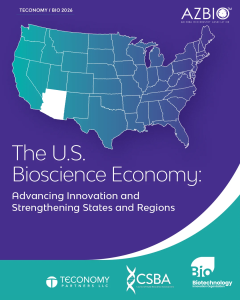
Get the AZ Fact Sheet
An innovation engine that keeps gaining speed
The job growth is backed by a deep and expanding innovation pipeline.
University research. Arizona universities spent $825.7 million on bioscience-related R&D in FY 2024. Biological and biomedical sciences led the way at $406.3 million, followed by health sciences at $248.5 million and agricultural sciences at $86.4 million.
NIH funding. NIH awards to Arizona institutions grew from $308.7 million in FY 2021 to $397.7 million in FY 2025. That’s a 29 percent increase, and FY 2025 was the strongest year of the five.
Venture capital. Investors put nearly $1.5 billion into Arizona bioscience companies from 2021 through 2025, placing the state in the second quintile nationally. 2025 was the best year of the period at $383.7 million, up 54 percent from 2024. Digital health led all segments with $663.2 million, followed by therapeutic devices at $227.0 million and drug discovery at $194.1 million.
Patents. Arizona inventors were affiliated with 3,002 bioscience-related patents over the five years, another second-quintile showing. Annual patent counts have climbed every year since 2022, reaching 628 in 2025. Medical and surgical devices accounted for 1,842 of those patents, more than 60 percent, underscoring the state’s medtech strength.
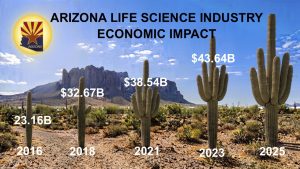
AZBio will unveil the latest economic impact data as well as where Arizona has risen in the national rankings at the Trailblazers luncheon on December 10, 2026 in Phoenix.
What it means for Arizona
The numbers tell a clear story. Arizona’s bioscience ecosystem is adding companies, creating high-wage jobs, and attracting the research dollars and private capital that fuel the next wave of breakthroughs.
There’s still room to run. On a per-capita basis, Arizona’s academic bioscience R&D ($109 per resident vs. $203 nationally) and NIH funding ($52 vs. $107) trail the U.S. average. Closing that gap is one of the biggest opportunities we have to turn today’s momentum into long-term leadership.
AZBio will unveil the latest economic impact data as well as where Arizona has risen in the national rankings at the Trailblazers luncheon on December 10, 2026 in Phoenix.
Whether you’re launching a startup, growing a team, or investing in what’s next, there’s never been a better time to be part of Arizona’s life science community. Let’s keep building.
Source: TEConomy Partners and BIO, The U.S. Bioscience Economy: Advancing Innovation and Strengthening States and Regions (2026), Arizona State Profile.
About AZBio
A key component in Arizona’s life science ecosystem, the Arizona Bioindustry Association (AZBio) is the only statewide organization exclusively focused on Arizona’s growing bioscience industry. AZBio membership includes patient advocacy organizations, life science innovators, educators, healthcare partners and leading business organizations. AZBio works in partnership with its members and partners across Arizona as well as nationally and internationally to advance innovation and to ensure that the value delivered from life-changing and life-saving innovation benefits people in Arizona and around the world. For more information visit www.AZBio.org.