The ACE Scholars Program was founded by an ASU researcher based on her experience working in labs as a student
Molecular and cellular biology doctoral student Harley Richker (left) helps Baciu lead a group of students during a hybrid meeting of ACE Scholars on Wednesday, Oct. 21. Richker says the program changed the course of his career. Photo by Charlie Leight/ASU News
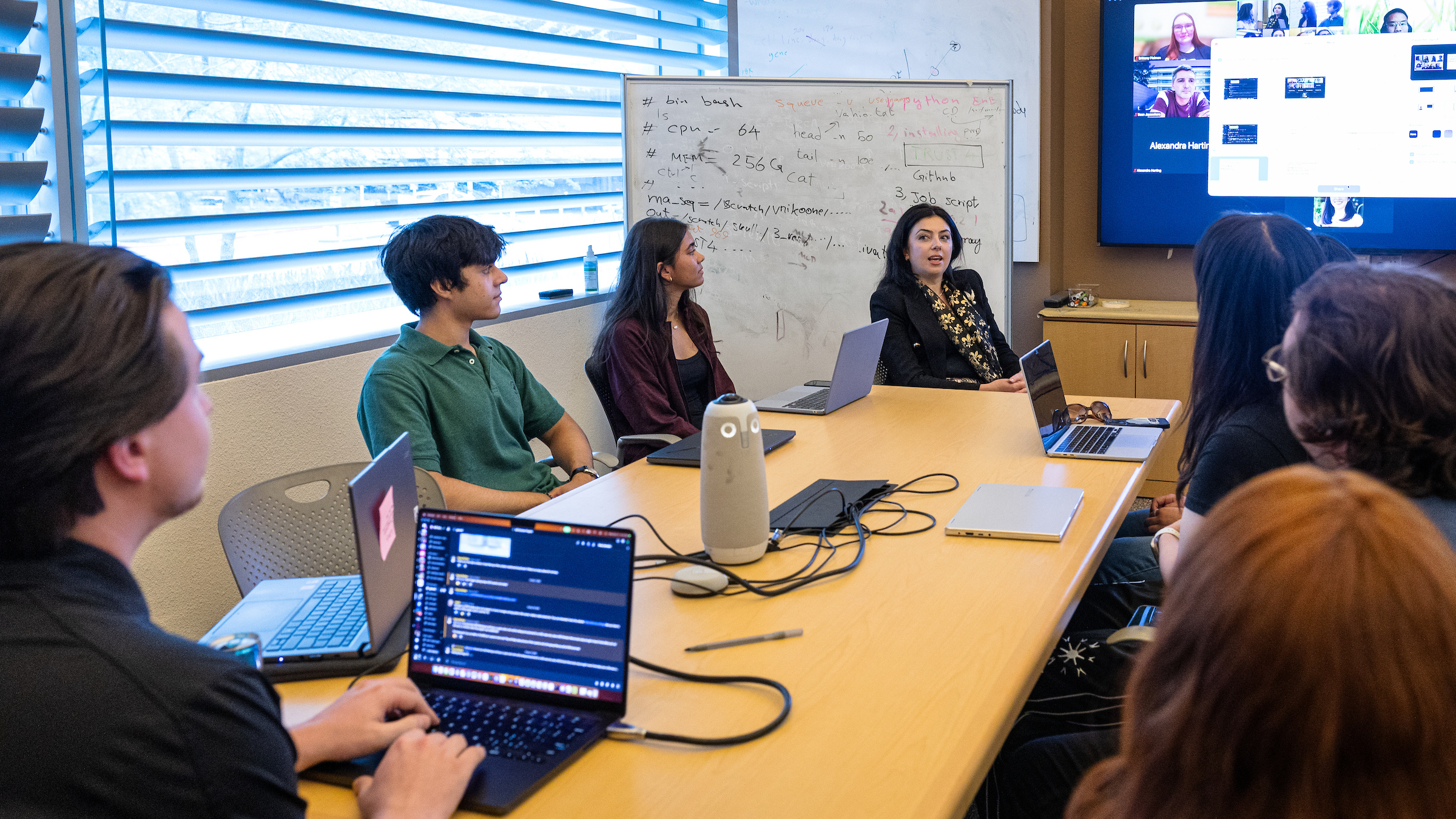
Cristina Baciu, founder of the ACE Scholars Program at ASU, leads a group of 25 students in a hybrid meeting on Wednesday, Oct. 21. Baciu recently published a study in Frontiers in Education introducing a research-based framework for designing mentoring systems that strengthen students’ sense of belonging, persistence and overall development. Photo by Charlie Leight/ASU News
After struggling to find her way into academic research, Cristina Baciu launched the ACE Scholars Program at ASU.
The program provides a research community where students can explore cancer science while gaining the guidance and confidence to pursue their own paths.
Baciu recently published a study in Frontiers in Education introducing a research-based framework for designing mentoring systems that strengthen students’ sense of belonging, persistence and overall development.
Her recently published book “Beyond the Campus: The Power of E-Mentoring in Modern Higher Education” explores how mentoring can be intentionally redesigned for the digital age.
As an international student from Romania trying to find her way into academic research at a U.S. institution, Cristina Baciu found herself struggling to navigate an unfamiliar educational system.
In her first weeks, even a professor’s invitation to debate in class felt foreign. Back home, students were expected to memorize, not challenge.
When Baciu went to her psychology professor’s office hours, she could explain her uncertainty better than her ambitions. He walked her down the hall to his laboratory, where undergraduates, graduate students and postdoctoral researchers worked together, and invited her to stay, observe and discover what interested her.
Years later, that invitation helped inspire the ACE Scholars Program at Arizona State University.
Working with then-doctoral student Zachary Compton, Baciu created a research community where students could explore cancer science while gaining the guidance and confidence to pursue their own paths.
Launched in 2021 through the Arizona Cancer Evolution Center at ASU, the program brings online and on-campus undergraduates into research at the intersection of cancer biology and evolutionary theory. Students investigate topics ranging from why some animal species rarely develop cancer to how people find and understand information about the disease.
“I did this because somebody did that for me many years ago, and it literally changed my trajectory,” said Baciu, now an assistant director of research at ASU’s W. P. Carey School of Business. “So I just wanted to do something similar for somebody else.”
Now, she’s taking it one step further by sharing her strategy so that others can follow her example.
Recently, Baciu published a study in Frontiers in Education introducing a research-based framework for designing mentoring systems that strengthen students’ sense of belonging, persistence and overall development. In addition, Baciu’s recently published book “Beyond the Campus: The Power of E-Mentoring in Modern Higher Education” explores how mentoring can be intentionally redesigned for the digital age.
Faculty member gesturing while speaking to students in front of a whiteboard full of notes.
Cristina Baciu, founder of the ACE Scholars Program at ASU, leads a group of 25 students in a hybrid meeting. Baciu was inspired to create the program, which provides a community where students can explore cancer science while gaining the guidance and confidence to pursue their own paths, after a professor provided similar guidance when she was an undergrad. Photo by Charlie Leight/ASU News
A team-based approach
The ACE Scholars Program took shape during the pandemic, when Baciu was beginning her doctoral studies and worrying about students who had suddenly been cut off from their laboratories. She and Compton began bringing students together online, initially giving them a place to connect. A pilot program followed in spring 2021.
From the beginning, Baciu wanted students to have several people they could turn to. Small research teams gave them opportunities to build friendships, ask questions and learn from both peers and more experienced researchers.
That team-based approach also addressed a practical challenge for Carlo Maley, director of the Arizona Cancer Evolution Center and a professor in ASU’s School of Life Sciences and Biodesign Center for Biocomputing, Security and Society.
Undergraduates were seeking research opportunities faster than his laboratory could accommodate them individually.
“I have a hard time saying no to a young, excited scientist,” Maley said. “They’re passionate about research and wanting to make the world a better place.”
Rather than relying exclusively on one-to-one mentorship, the program distributes guidance across teams. Experienced undergraduates can lead projects while graduate students and postdoctoral researchers serve as scientific advisers. Newcomers learn from researchers at several stages of their careers.
The projects are designed to produce publishable research. Because much of the work involves collecting and analyzing data, students can contribute from wherever they live. Prior coding or bioinformatics experience is not required; students receive training in the methods their projects demand.
Students also learn how to present scientific findings, prepare graduate school applications and explore career options. According to the ACE Scholar fact sheet, the program has served more than 175 students, who have delivered more than 110 talks and poster presentations and received more than 23 presentation awards.
From uncertain undergrads to confident researchers
For Harley Richker, the opportunity to be an ACE Scholar changed the course of his career.
Richker was a premedical student struggling to secure a laboratory position when he joined the program in fall 2021. He soon discovered that research — not medicine — was the path he wanted to pursue.
Richker became a team leader, earned a bachelor’s degree in biomedical sciences and continued into graduate study. Now a doctoral student in molecular and cellular biology and co-director of ACE Scholars, he helps students navigate the uncertainty he once experienced.
“Watching them go from a place of uncertainty and zero experience to graduate school, medical school or research is incredibly special for me,” Richker said.
After a course taught by Maley sparked Bailey Kane’s interest in studying cancer through ecological and evolutionary principles, she joined ACE Scholars in spring 2024 and found a community in which to pursue that interest.
Kane earned a bachelor’s degree in genetics, cell and developmental biology in 2025, and later served as an ACE Scholars co-director. Along the way, conversations with graduate students made advanced study feel more attainable. Kane learned how doctoral funding works, what different degrees programs involve and how to prepare a competitive application.
Kane credits the program with helping her secure a place in the cancer biology doctoral program at the Institute of Cancer Research in London.
“I met some of my best friends in this program,” Kane said. “And it’s really given me a lot in that way.”
For students just beginning their research journeys, that combination of scientific guidance and personal connection can make it easier to ask questions.
Lyndell Tanner, a second-year student double-majoring in data science and biomedical sciences, wanted to apply computational skills to cancer research after the disease affected a family member. Tanner joined a comparative oncology project examining why susceptibility and resistance to cancer vary across species.
Tanner’s team includes other beginning researchers, a doctoral student and a postdoctoral researcher.
“I feel comfortable reaching out to both — or really anyone — with any level of question,” Tanner said.
Second-year biomedical engineering student Kavi Badhwar also came to the program after a family experience with cancer. Through a project examining skin cancer data from zoo animals, Badhwar is learning how researchers investigate differences in cancer prevalence among species.
Badhwar said the program’s range of opportunities — including laboratory research, data analysis and education — has expanded his understanding of how students can contribute.
Students talk during a research meeting.
Ella Peterman, a third-year double-major in biological sciences and ocean futures, offers her thoughts during a breakout session of ACE Scholars on Wednesday, Oct. 21. Photo by Charlie Leight/ASU News
The flexibility to realize potential
For one former ASU student, the program’s flexibility opened a path that had once seemed closed.
After moving frequently and transferring between colleges, Melanie Aldridge enrolled in ASU’s online biochemistry program to avoid losing more credits. But pursuing science beyond a bachelor’s degree presented a challenge: How could an online student gain research experience without access to a laboratory?
ACE Scholars provided an answer.
From August 2022 through May 2023, Aldridge worked on several projects, including a study of how people obtain cancer information and how informed they feel when making health care decisions. Aldridge also presented posters and contributed to a preprint.
The program also gave Aldridge something new: a mentor focused on educational goals. Baciu helped Aldridge identify those goals and the steps needed to reach them.
Aldridge went on to complete a post baccalaureate program at the National Institutes of Health and is now pursuing a doctorate in cancer biology at Vanderbilt University.
Aldridge’s progression echoes Baciu’s own experience: an invitation to participate, room to grow and a future that became easier to imagine. Baciu continues to advise ACE Scholars, while former participants guide the students who come after them.
For Aldridge, the program’s lasting impact began with recognizing what was possible.
“It opened my eyes to my potential,” Aldridge said, “and to what I needed to do to get to where I wanted to go.”
By Marshall Terrill |
November 20, 2026
SOURCE: https://news.asu.edu/20261120-science-and-technology-mentoring-program-helps-asu-undergrads-find-their-footing-cancer