
A core aspect of professionalism for physicians is advocating for patients and a healthy community.
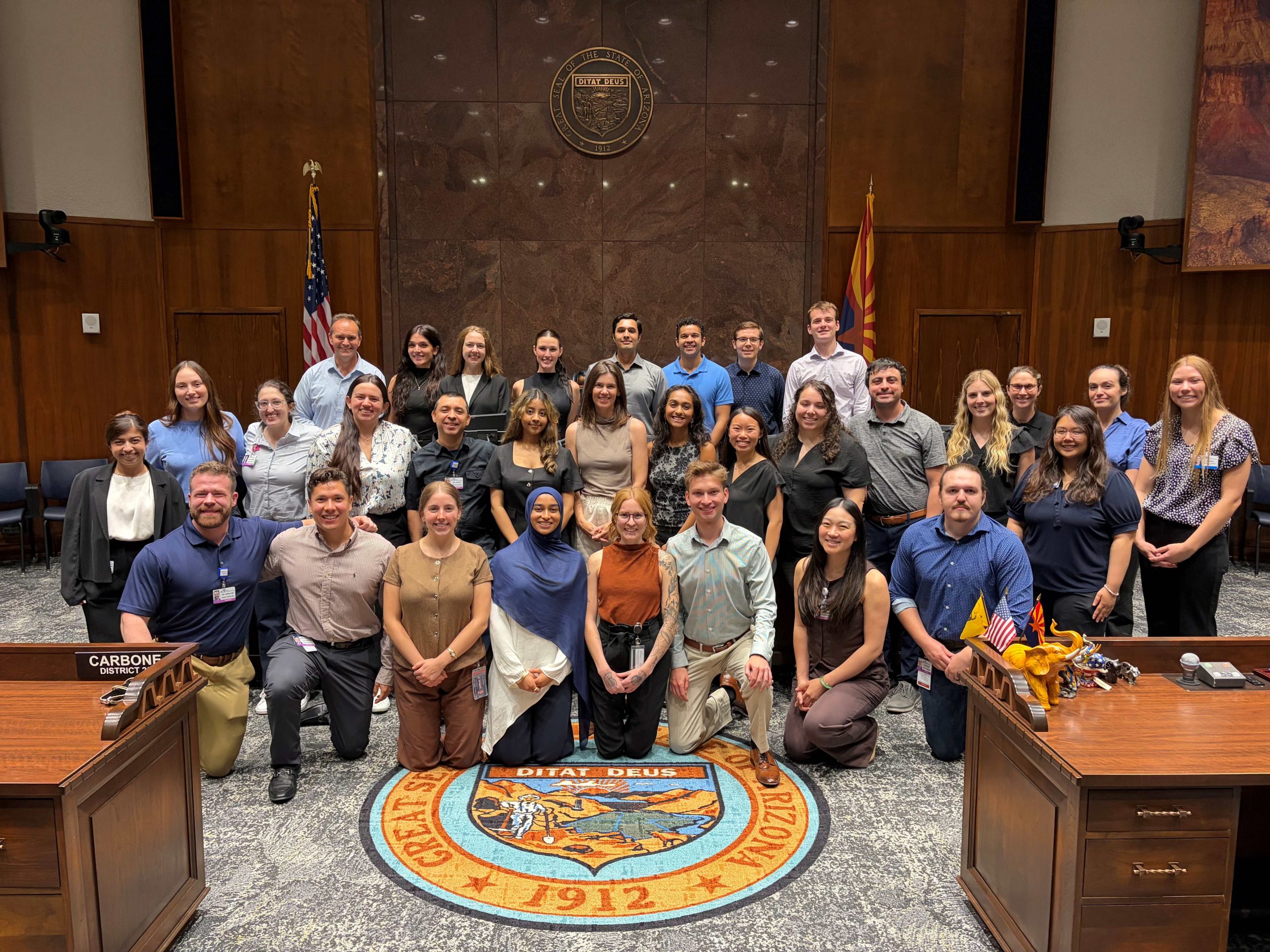
Medical students and residents — with Representative Sarah Ligouri — visited the Arizona State Capitol to learn how they can advocate for the future of health care in the state.
On July 20, students and residents affiliated with the University of Arizona College of Medicine – Phoenix demonstrated this through an advocacy event and visit to the Arizona Capitol to educate aspiring physicians on how to use their individual and collective voices to enact change.
Steven R. Brown, MD, FAAFP, program director of the U of A College of Medicine – Phoenix’s Family Medicine Residency – Phoenix, hosted a gathering that medical students and residents associated with the medical school attended.
The group directly engaged with people on the floor of the Arizona House of Representatives — such as Representative Sarah Ligouri from Legislative District 5 in Central Phoenix — who will help them meet the needs of underserved populations in Arizona.
“Our visit to the Arizona Capitol, where learners get to meet a legislator and hear about the legislative process, helped students overcome the uncertainty about not knowing how best to invest their efforts to make a difference,” Dr. Brown said.
This year, students and residents discussed the importance of advocacy and learned how bills are created to become laws. Representative Ligouri listened to the students and residents about their concerns. A total of 13 medical students from the college and 15 residents from the various family medicine residencies associated with the college joined the visit.
Among the residents who attended the event was Tyler King, MD, a first-year Family Medicine resident at Banner – University Medical Center Phoenix. Dr. King said the meeting reminded her that making good changes is hard and takes passion and persistence.
“It seems simple, but we all walked away knowing exactly who our representatives are, how to get in touch with them and action steps to stay locally engaged,” Dr. King said. “As physicians, we regularly talk about the importance of advocacy work for our patients and the communities that we serve.”
For Dr. King, a major attraction to her current residency program was the opportunity to advocate for her community on a regular basis. She intends to continue these conversations to learn more how to best support her current and future patients.
“Whether it is through Capitol visits, funding the food pantry, organizing hygiene supplies to donate and many more activities, this group continuously engages with the community to listen to needs and seek solutions that extend beyond the four walls of an exam room,” Dr. King said.
Isha Paode, a second-year medical student at the College of Medicine – Phoenix, is the lead of the Community Health Initiative – Phoenix (CHIP), which aims to make advocacy more accessible.
A central part of the Certificate of Distinction (COD) in Service & Community Health, medical students engaged in the program benefit immensely from these practical experiences. They serve as a lesson in how to campaign for patients at a systemic level.
According to Paode, visiting the Capitol and meeting Representative Sarah Liguori gave her a clearer understanding of how physicians can engage with policymakers on issues that matter.
“I was heartened to see Representative Liguori’s interest in educating medical students and discussing opportunities for us to advocate,” Paode said. “It was similarly meaningful to assemble with students and residents who share a desire to contribute to a health care system that better meets the needs of our patients.”
After her experience volunteering with at-risk youth when she was in high school, Paode understands exactly how someone’s circumstances can affect their opportunities and outcomes.
“This showed me that there are major factors shaping health that lie beyond the clinical setting,” Paode said. “Advocacy is meaningful to me because it provides a path to address these factors rather than simply responding to their consequences.”
Alex Gilchrist, a third-year medical student at the College of Medicine – Phoenix, was drawn to the event because he wanted to address the systemic issues he has seen with his patients each day while in the clinic.
“This event demystified the process of turning bills into laws and showed just how feasible advocacy is, even as a medical student,” Gilchrist said. “Connecting directly with lawmakers made it clear that by using our expertise to shape policy, we can create a lasting impact for our patients and future generations.”
About the College
Founded in 2007, the University of Arizona College of Medicine – Phoenix inspires and trains exemplary physicians, scientists and leaders to advance its core missions in education, research, clinical care and service to communities across Arizona. The college’s strength lies in our collaborations and partnerships with clinical affiliates, community organizations and industry sponsors. With our primary affiliate, Banner Health, we are recognized as the premier academic medical center in Phoenix. As an anchor institution of the Phoenix Bioscience Core, the college is home to signature research programs in neurosciences, cardiopulmonary diseases, immunology, informatics and metabolism. These focus areas uniquely position us to drive biomedical research and bolster economic development in the region.
As an urban institution with strong roots in rural and tribal health, the college has graduated more than 1,000 physicians and matriculates 130 students each year. Greater than 60% of matriculating students are from Arizona and many continue training at our GME sponsored residency programs, ultimately pursuing local academic and community-based opportunities. While our traditional four-year program continues to thrive, we will launch our recently approved accelerated three-year medical student curriculum with exclusive focus on primary care. This program is designed to further enhance workforce retention needs across Arizona.
The college has embarked on our strategic plan for 2025 to 2030. Learn more.
By Chase Congleton
University of Arizona College of Medicine Phoenix