
The awards showcased the extraordinary talent shaping the future of science, arts, innovation and education at the University of Arizona
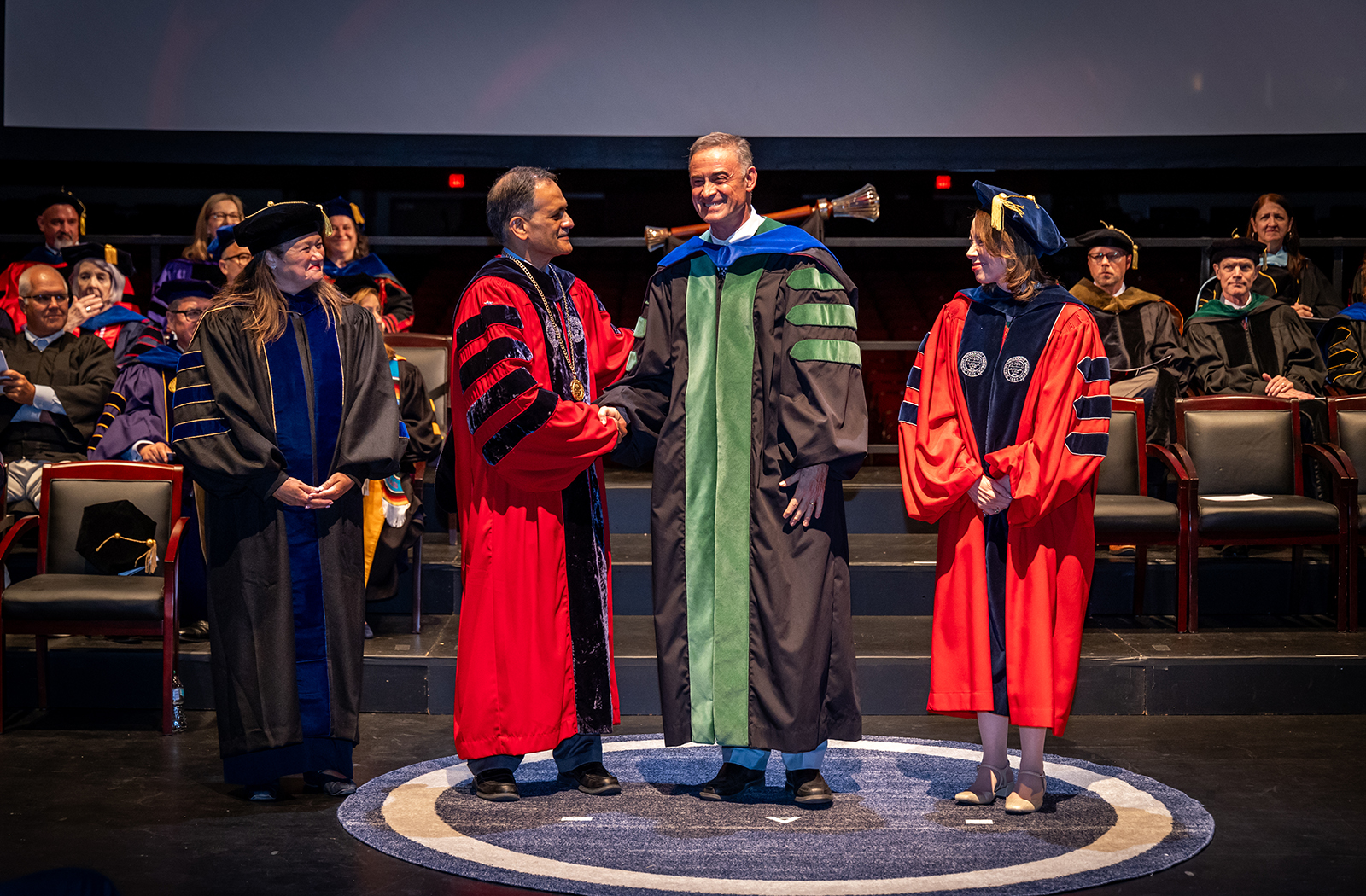
Janko Z. Nikolich, MD, PhD, shakes hands with U of A President Suresh Garimella at the Luminaries Outstanding Faculty Awards (photos courtesy of the University of Arizona).
An internationally recognized leader in immunology and gerontology, the career of Janko Z. Nikolich, MD, PhD, associate dean of Research and professor of Basic Medical Sciences with the University of Arizona College of Medicine – Phoenix, has been one of impactful research innovation and discovery. And for nearly two decades that groundbreaking work has been done with the U of A.
His contributions to the university’s mission to push the boundaries of knowledge — shaping a more resilient, equitable and sustainable world — began in 2008 when he joined the College of Medicine – Tucson to lead the Department of Immunobiology and the Arizona Center on Aging.
Dr. Nikolich’s time there and now with the College of Medicine – Phoenix has been defined by lasting and meaningful research inquiry.
The Luminaries Outstanding Faculty Awards were held in the U of A’s Centennial Hall in Tucson
“I am most proud of leading two U of A strategic initiatives, the Personalized Defense initiative and the Aegis Consortium for a Pandemic-free Future. Both came out of the realization that immunity and the immune system are the key players in our health and diseases,” he explained. “The second one was also born out of the U of A’s unprecedented and highly remarkable response to the COVID pandemic. The two initiatives engaged well over 200 faculty members across at least 10 colleges spanning the health sciences, the main campus, Tucson and Phoenix.”
Its success eventually extended to the other state universities — Arizona State University and Northern Arizona University — as well as national and international academic partners, state and federal governments, non-profit and for-profit organizations.
He’s also made great strides into debunking myths about aging. The conventional wisdom was that “In an older organism, the key white blood cells, called T lymphocytes, are simply not able to respond well to infections,” he said. “Instead, we found out that the poor immune responses to new infections are largely dictated by the aging of lymphoid organs where lymphocytes, including T lymphocytes, are maintained for decades and are activated to defend the organism once the infection strikes.” This realization allowed them to take a renewed look at how to rejuvenate the immune system.
Those studies and many more are emblematic of why he was recently chosen to be honored as a Regents Professor at the U of A’s 2026 *Luminaries Outstanding Faculty Awards, a recognition that was extremely meaningful.
“It was an amazing moment for me,” said Dr. Nikolich. “It meant the ultimate appreciation by my peers at my university. It also meant validation of a decade and a half of not only my scientific work, but also of efforts to initiate and lead larger trans-disciplinary initiatives across the many colleges and departments on campus.”
It was humbling for him to be recognized alongside so many of his aspirational colleagues across disciplines with the U of A. From educational breakthroughs in astrophysics to novel microscope inventions to unlocking the secret connections between gut and brain health, Dr. Nikolich was celebrated among some of the most superb minds at the university.
“Being the only Regents Professor honored among that sea of talent and brilliance was very special,” he said.
But, for Dr. Nikolich, the work is not done. With the college, he is seeking to build new initiatives to better understand how immunity, inflammation and aging contribute to chronic diseases — including age-associated frailty, chronic lung, liver and kidney diseases, as well as complex chronic and post-infection conditions such as Long COVID and myalgic encephalomyellitis – chronic fatigue syndrome (ME-CFS). “The goal is to set the stage for both discovery of mechanisms and targets and for eventual treatments via translational and clinical trial work,” he said.
He will be intimately involved with the progress toward these goals ; Dr. Nikolich’s lab works directly on many of those themes. In addition, he will focus on improving the function of an older immune system by immune engineering and immune regeneration.
*From groundbreaking discoveries to transformative teaching, the faculty members chosen for the Luminaries Outstanding Faculty Awards represent the pinnacle of intellectual achievement. Their work illuminates classrooms, labs and communities alike, embodying the Wildcat spirit of curiosity, creativity and commitment to student success.
About the College
Founded in 2007, the University of Arizona College of Medicine – Phoenix inspires and trains exemplary physicians, scientists and leaders to advance its core missions in education, research, clinical care and service to communities across Arizona. The college’s strength lies in our collaborations and partnerships with clinical affiliates, community organizations and industry sponsors. With our primary affiliate, Banner Health, we are recognized as the premier academic medical center in Phoenix. As an anchor institution of the Phoenix Bioscience Core, the college is home to signature research programs in neurosciences, cardiopulmonary diseases, immunology, informatics and metabolism. These focus areas uniquely position us to drive biomedical research and bolster economic development in the region.
As an urban institution with strong roots in rural and tribal health, the college has graduated more than 1,000 physicians and matriculates 130 students each year. Greater than 60% of matriculating students are from Arizona and many continue training at our GME sponsored residency programs, ultimately pursuing local academic and community-based opportunities. While our traditional four-year program continues to thrive, we will launch our recently approved accelerated three-year medical student curriculum with exclusive focus on primary care. This program is designed to further enhance workforce retention needs across Arizona.
The college has embarked on our strategic plan for 2025 to 2030. Learn more.
By Thomas Kelly, University of Arizona College of Medicine – Phoenix