
Nutrition efforts, biomedical workforce, new medical school among the initiatives covered
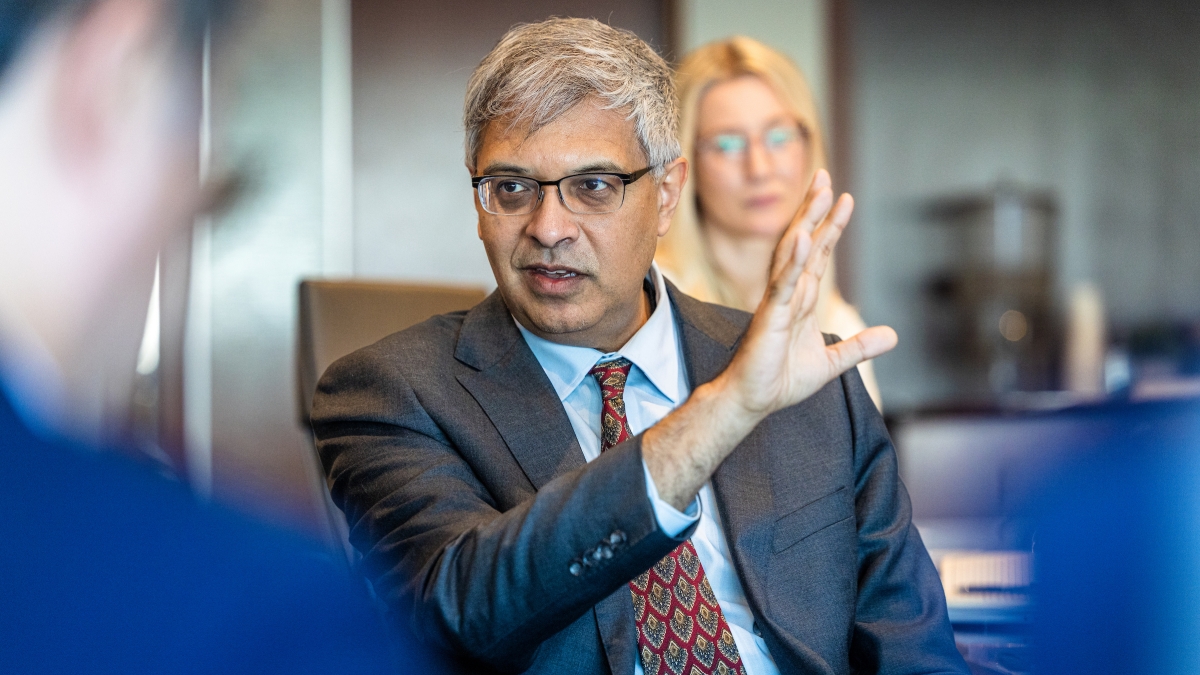
National Institutes of Health Director Jay Bhattacharya speaks during a visit Tuesday at the Fulton Center on the Tempe campus. Interdisciplinary groups across ASU — including people representing ASU Health, Knowledge Enterprise, the biomedical workforce and Food Is Medicine — discussed their work with Bhattacharya. Photo by Charlie Leight/ASU News
Morton, the executive vice president of Arizona State University’s Knowledge Enterprise, told Bhattacharya about all the research and work being done at ASU, and in particular, ASU Health.
“When she was telling me that, I was very excited to come and see myself,” Bhattacharya said.
He did just that on Tuesday, spending several hours with leadership and faculty throughout ASU Health, touring the Tempe campus and engaging in a conversation with university President Michael Crow.
Bhattacharya said he came away impressed by what he saw and heard.
“It’s very clear that ASU is an amazing institution that is thinking of innovative ways to make America healthy,” he said. “The idea that ASU takes responsibility for the health of the community around it is completely aligned with the NIH mission, which is the research that we do needs to translate to better health for people and better, longer lives.”
Bhattacharya’s morning and early afternoon consisted of meetings focused on ASU Health, Knowledge Enterprise, the biomedical workforce and ASU’s “food is medicine” efforts, which involve collaborative research, community outreach and educational events focused on using nutrition to prevent and manage chronic diseases.
ASU Health

Sherine Gabriel, the executive vice president of ASU Health, said ASU is approaching its “health enterprise” in a different way than most universities.
ASU Health is a collaborative approach that includes the John Shufeldt School of Medicine and Medical Engineering, the School of Technology for Public Health, the Edson College of Nursing and Health Innovation, the College of Health Solutions, the Medical Master’s Institute and the Health Observatory at ASU.
“Our north star is improving health outcomes,” Gabriel said.
College of Health Solutions Dean Michael Yudell noted that his college includes 40 degree programs across eight disciplines, including nutrition, speech and hearing science, health policy, biomedical diagnostics and behavioral health.
Jyoti Pathak, the dean of the School of Technology for Public Health, said ASU has partnered with outside industries and health care providers like the Arizona Department of Health Services, which is dedicated to the health and wellness of Arizonans.
“A strong DNA that we are trying to create is that we embrace social entrepreneurship,” Pathak said. “Typically, when you see public health schools, faculty and students don’t engage with industry that much. But we are trying to establish a public health tech incubator.”
ASU Health also is committed to helping rural Arizonans. One example is the Learn Where You Live initiative, which aims to make nursing degrees more accessible to students throughout the state of Arizona by bringing their classwork to them.
Judy Karshmer, the dean of the Edson College of Nursing and Health Innovation, told Bhattacharya that the college has recruited student nurses to serve in rural Arizona communities like Parker and Payson.
“We’ll be able to educate (students) who live in those communities, who hopefully will stay in those communities and be the nurses for those communities,” she said.
Bhattacharya praised the program.
“The nursing needs in this country are tremendous,” he said.
Knowledge Enterprise

Neal Woodbury, chief science and technology officer of Knowledge Enterprise, said ASU’s “reinvention” of the idea of medical school is not just needed but vital to improving health outcomes.
“Frankly, Arizona needs a lot of reinvention in terms of the way it’s thinking about health,” Woodbury said. “We’re working with the health department and others to try and make this happen. So it’s a great time to have a conversation about what that should look like and how we should move forward in an economically viable way and in a sustainable way that can be accessed by the entire population.”
One way ASU hopes to do that, said Dave Engelthaler, executive director of the Health Observatory, is to use data to help the state of Arizona identify, track and mitigate future health crises.
“Our tagline (at the observatory) is, ‘We’re transforming health data into health knowledge,’” Engelthaler said. “The government gives us very little information about what’s really happening in our populations. So we’re trying to bring together all the unique health data sources … and bring that data together in a secure way, really ensuring privacy protection but also ensuring ethical use for research.”
Grace O’Sullivan, ASU’s vice president of corporate engagement and strategic partnerships, spent a few minutes telling Bhattacharya about the university’s eight Innovation Zones, geographical/real-estate portfolios that ASU runs, or is a partner in, with the goal of co-locating private companies, faculty, students and university research infrastructure. In turn, students receive exposure to real industry problems, internships and project-paid learning.
O’Sullivan said two of the zones are focused on health care, including the Discovery Oasis, home of Mayo Clinic and ASU Alliance for Health Care.
The zones, O’Sullivan said, benefit companies and students interested in making health care their career.
“What we’re doing is attracting these companies to co-locate with us to make research more impactful, to get industry investments with us and to enable hands-on training for our students,” she said. “So they have this really amazing engagement working on these real-world problems while they’re in school. Then, they get snapped up by these employers and industry upon graduation.”
Biomedical workforce

Heather Clark, senior associate dean for engineering integration in the John Shufeldt School of Medicine and Medical Engineering, explained to Bhattacharya that students in the school will receive a Doctor of Medicine and a Master of Science in medical engineering in four years.
Clark said students also will learn how data is generated.
“I feel very strongly that everybody should understand how data gets to them and how much to trust it, and then using those concepts to reinforce the medical curriculum through the lens of engineering,” Clark said. “So, as they’re studying the heart, we will be reinforcing that through engineering.
“The heart has valves, pumps, fluid flow and signal generation, and they’ll be learning all that. And once they’re out of their coursework, we’re going to move into an innovation phase in which they’re going to treat their clerkship as if this is the absolute best engineering fact-finding mission of their lives.”
Bhattacharya said the combination of medicine and engineering “sounds amazing.”
“It’s like the physics — the physics of the physiology as well as workflow things,” he said. “It’s like you’re reengineering medicine.”
Dan Cox, dean of natural sciences in The College of Liberal Arts and Sciences, said ASU also is reimagining the training of the biomedical workforce because studies show that only one-third of students who start in STEM majors (science, technology, engineering and math) graduate.
ASU is addressing that problem, Cox said, with Dreamscape Learn, a virtual reality storytelling experience that transforms biology labs into alien ecosystems, starting with introductory biology. Dreamscape Learn has recently expanded into chemistry and other areas.
At ASU, a study in fall 2022 showed that students in Dreamscape Learn courses were 1.7 times more likely to receive an “A” grade in their lab assignments, with a median score of 96%. Students were also highly engaged in the content, rating the experience an average 4.4 out of five. A later, larger-scale study found similarly positive outcomes.
“The big message is that they’re staying in the major and finding connectivity to those concepts, whether it’s biology or chemistry,” Cox said.
Dreamscape Learn and the Shufeldt School of Medicine and Medical Engineering are just two examples of ASU’s innovative approach to health care, Cox said.
“Everything about ASU,” he told Bhattacharya, “is not doing things the way that everybody else does them.”
Food is medicine

Chris Wharton, a professor of nutrition in the College of Health Solutions, said the college is thinking of ways health care education can frame itself around Principled Innovation, one of Crow’s nine core design aspirations.
“When we come up with new ideas, we need to be guided by principles to make sure they have a positive impact on humanity,” Wharton said. “One of the projects we’ve been working on is how to literally introduce character development education within our college and within the medical school so that we’re getting our students prepared to be successful health practitioners but also giving them ways to build their character and be the best person they can be walking out our door.”
One example: a culinary medicine program in which students would learn in a test kitchen how to cook healthy on a budget or with ingredients that are specific to different cultures. Then, after entering the health care field, they could use that knowledge to help create nutrition programs for their patients.
Bhattacharya applauded the idea, noting that doctors don’t often think about nutrition when it comes to treating patients.
Richard Leach told Bhattacharya about ASU’s Food Is Medicine initiative, of which he is executive director. The initiative trains future health care professionals to use nutrition to prevent and treat chronic diseases.
The need for such a program is clear, Leach said. Studies show about 11 million deaths annually are related to poor diets. In 2023, an estimated 8.4 million U.S. adolescents (ages 12-17) had prediabetes, according to the U.S. Centers for Disease Control and Prevention, a significant increase from previous estimates.
Leach said the initiative has five strategies: care delivery, education, public policy, public knowledge and research. Since September, he added, 10 working groups involving up to 80 faculty members throughout campus have begun.
“Clearly, with the numbers out there, we have to do something,” he said.
Near the end of the meeting, Yudell said ASU Health can be at the forefront of improving health outcomes not only locally — Arizona ranks 34th for overall health outcomes — but nationally.
“One of the things we want to build into ASU Health is thinking about how our research and how our training is moving the needle in those spaces,” he said. “Given the role of Arizona in both the educational and political ecosystem, I think there’s a lot of opportunity here for us to transcend the moment in a lot of interesting ways to really make positive changes.”

AUTHOR:
Scott Bordow | ASU News
SOURCE: https://news.asu.edu/20260116-health-and-medicine-nih-directors-visit-focuses-asus-health-research-education