
For the second straight year, the University of Arizona College of Medicine – Phoenix hosted Research Week. The series of events, bridged between two weeks, served as a fantastic showcase for how the college and its partners are driving discovery and fueling the future of healthier Arizona.
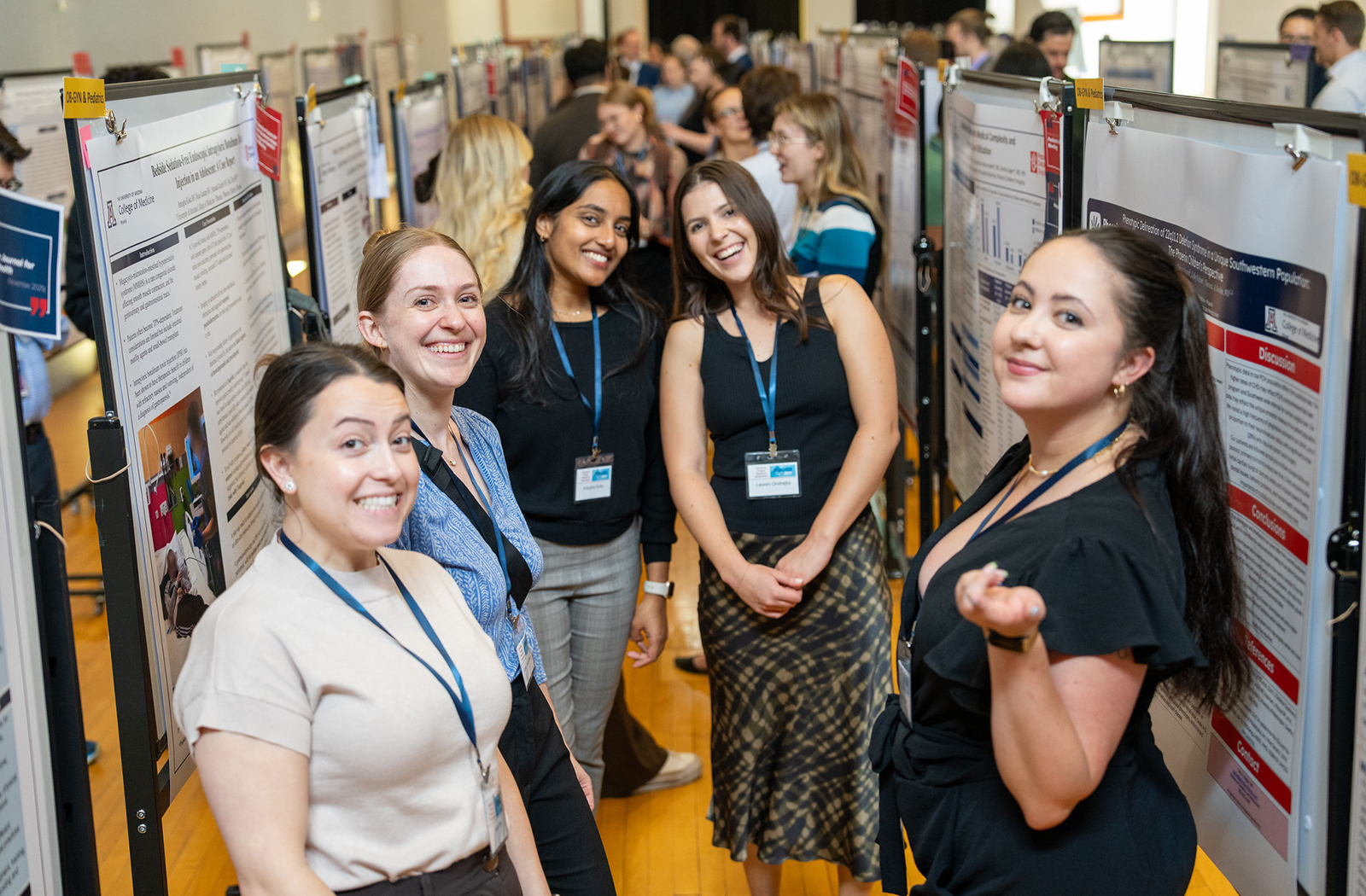
Chris Glembotski, PhD, vice dean of Research and director of the Translational Cardiovascular Research Center, spoke to how the event has grown and the value it brings to the college. “Research is a critical element of medical education, as well as scientific graduate and postdoctoral education. The amount and level of research conducted at our college has continually grown over the last 10+ years; evidence of this can be seen in the total number of attendees across all five days — totaling 793 with a record 245 attendees on the final day when we held the 11th Annual ABRC-Flinn Research Conference,” he said.
“We thank our students, staff and faculty for their research contributions and participation in the weeklong program. And a special thank you goes to our Research Office staff who worked tirelessly before and during the event to ensure a highly successful Research Week at the U of A College of Medicine – Phoenix,” he added.
Held from April 29 to May 5 — excluding the weekend — it featured each of the events below and more.
30th Annual Michael D. Grossman, MD, MACP, Academic Excellence Day
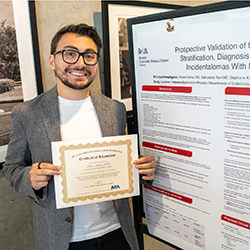
At AED, Adam Zakkar, DO, who finished second in the Fellow – Research/Quality Improvement category, poses with his poster.
Promoting an environment of academic excellence amongst trainees at the participating institutions, the 30th Annual Michael D. Grossman Academic Excellence Day provided an opportunity for residents and fellows in training programs in the greater Phoenix area to showcase the volume of bench and clinical research and quality improvement initiatives being performed at their hospitals. Sponsored by the MICA Medical Foundation, this year featured a hybrid format with virtual posters and in-person oral presentations.
Biomedical Research Day: Bridging Science and Health
Biomedical Research Day saw the latest discoveries by faculty speakers as well as undergraduate, graduate and postdoctoral trainees at the U of A College of Medicine – Phoenix presented.
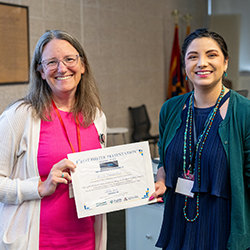
Taben Hale, PhD, with Nicole Jimenez, PhD, a postdoctoral fellow in the lab of Melissa Herbst-Kralovetz, PhD, congratulating her on finishing second in the poster presentations.
The keynote presenters were Camila de Avila Dal Bo, PhD, assistant research professor in the Department of Translational Neurosciences; Christian Bime, MD, division chief of Pulmonary, Critical Care and Sleep Medicine; and Iannis E. Adamopoulos, BSc (Hons), MPhil, DPhil, vice chair of Research for the Department of Internal Medicine.
Their presentations were The Nucleus Incertus of the Brain: What Do We Know?; Acute Respiratory Distress Syndrome: Translational Approaches to Uncover Novel Therapeutic Targets; and Cytokine Regulation of Autoimmunity respectively.
In addition to their talks, all trainees were invited to prepare posters to present their research findings. Top abstracts in Cardiovascular/Pulmonary, Neuroscience and Cancer, Cell Biology and Immunology were selected for oral presentations (photos from the event).
Award Recipients
Oral:
- First Place – Shriya Singh, Exploring the Therapeutic Potential of Atomic Drugs.
- Second Place – Ashkan Khanishayan, MS, Point-of-care radiation biodosimetry via a body-heated RT-RPA coupled to a paper-based VFI.
Posters:
- First Place – Christina Lyons, BS, The Role of CD36 in Erythroid Differentiation of Human Hematopoietic Stem and Progenitor Cells.
- Second Place – Nicole Jimenez, PhD, Exploring the Interconnection Between Endometriosis, Anxiety, and the Vaginal and Rectal Microbiome at Time of Gynecologic Laparoscopic Surgery.
Research Education and Career Development Day
With a series of events spread out over the course of the morning and afternoon, Research Education and Career Development Day was an excellent opportunity for current students and aspiring researchers to hear diverse perspectives on careers in the health sciences.
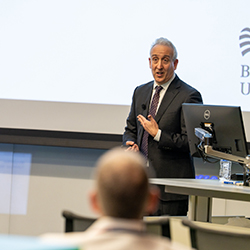
During the event, Dr. Casper delivered a special Grand Rounds presentation.
The day commenced with a special Grand Rounds presentation from Corey Casper, MD, MPH, professor and clinical scholar in the Department of Internal Medicine at the College of Medicine – Phoenix and chief research officer with Banner Health.
This was followed by a special talk from Rong Wang, president and CEO of NuvOx Therapeutics and Evan Unger, MD, co-founder and executive chairman. Hosted by the Center for Biotech Research Development and Entrepreneurialism (BRDE), their presentations shed light on the noble causes and complexities of the biotech/life sciences industry, as well as their experiences in running the finance, operations and business development aspects of NuvOx Therapeutics.
The day also featured a presentation focused on the U of A Health Sciences Library’s education initiative and welcomed the U of A Office of Research and Partnerships to share their available resources.
16th Annual Scholarly Project Research Symposium
Since the college’s inception, medical students have designed and successfully completed longitudinal, hypothesis-driven research — their Scholarly Project. The annual symposium serves as a forum for attendees to engage with the current class about their research focuses during multiple poster sessions.
Like the classes before them, the Class of 2026 worked closely with mentors over the course of their medical studies — discovering the importance of medical information literacy, life-long learning, teamwork, effective communication, research methods, evidence-based medicine approaches and ethics related to scholarly inquiry.
11th Annual ABRC-Flinn Research Conference
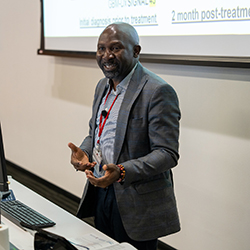
Dr. Fonkem shared his ongoing neuro-oncology research at the conference. This conference brought together grant awardees from the Arizona Biomedical Research Centre and the Flinn Foundation to showcase their research advances through poster and oral presentations. An all-day event, it was bookended by presentations from distinguished speakers Dr. Casper and Ekokobe
- Photos from the event.
- About the College
Founded in 2007, the University of Arizona College of Medicine – Phoenix inspires and trains exemplary physicians, scientists and leaders to advance its core missions in education, research, clinical care and service to communities across Arizona. The college’s strength lies in our collaborations and partnerships with clinical affiliates, community organizations and industry sponsors. With our primary affiliate, Banner Health, we are recognized as the premier academic medical center in Phoenix. As an anchor institution of the Phoenix Bioscience Core, the college is home to signature research programs in neurosciences, cardiopulmonary diseases, immunology, informatics and metabolism. These focus areas uniquely position us to drive biomedical research and bolster economic development in the region.
As an urban institution with strong roots in rural and tribal health, the college has graduated more than 1,000 physicians and matriculates 130 students each year. Greater than 60% of matriculating students are from Arizona and many continue training at our GME sponsored residency programs, ultimately pursuing local academic and community-based opportunities. While our traditional four-year program continues to thrive, we will launch our recently approved accelerated three-year medical student curriculum with exclusive focus on primary care. This program is designed to further enhance workforce retention needs across Arizona.
The college has embarked on our strategic plan for 2025 to 2030. Learn more.
By Thomas Kell, The University of Arizona,