Initial Distribution Prioritized for Frontline Healthcare Workers and First Responders
Author Archive: AZBio
Quest Diagnostics Begins to Perform COVID-19 Antibody Testing
SECAUCUS, N.J., April 21, 2020 /PRNewswire/ — Quest Diagnostics (NYSE: DGX), the world’s leading provider of diagnostic information services, today announced that it has begun to perform antibody testing for coronavirus (COVID-19) using blood samples. With the new service, Quest Diagnostics now provides healthcare providers in the United States access to COVID-19 antibody as well as molecular diagnostic laboratory testing. Continue reading
Banner Health expands telehealth for COVID-19
Virtual visits provide instant access to medical providers in safe environmentContinue reading
GenoSensor Granted FDA Emergency Use Authorization for High Throughput COVID-19 RT-PCR Diagnostic for Use in U.S.
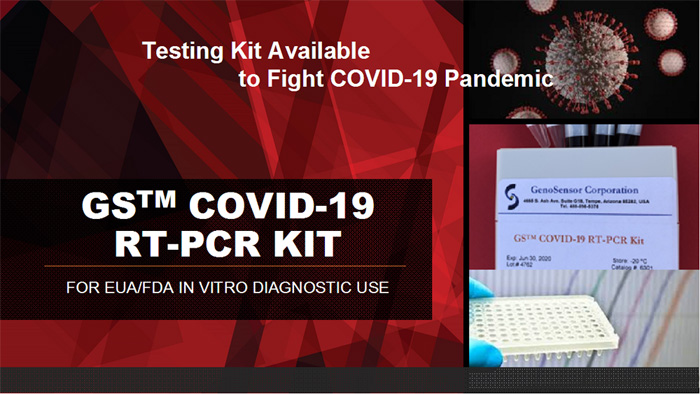
- FDA Emergency Use Authorization for the GSTM COVID-19 RT-PCR KIT was issued on April 16, 2020. View FDA Letter: https://www.fda.gov/media/137090/download
- With a high sensitivity detection (single copy detection) when run according to its instructions for use in a qualified clinical lab, the GSTM COVID-19 RT-PCR test, is one of the most sensitive tests currently available under an FDA Emergency Use Authorization.
- GSTM COVID-19 RT-PCR KIT runs on the Applied Biosystems™ 7500 Fast Dx Real-Time PCR Instrument. Kits are available for the 96 well plate (22 clinical samples) and 384 well plate (94 clinical samples) and provides test results in less than 90 minutes.
- The GSTM COVID-19 RT-PCR KIT is intended for use by trained clinical laboratory personnel specifically instructed and trained in the techniques of real-time PCR and in vitro diagnostic procedures. Instructions for use, the FDA EUA letter, and other documentation is provided at GenoSensorCorp.com.
UArizona Launches Two-Way Texting System to Gather and Provide Critical COVID-19 Health Data
TUCSON, Ariz. – Designed to address a critical lack of local data as the COVID-19 pandemic continues to spread, a University of Arizona team of researchers from UArizona Health Sciences and the Data Science Institute is launching a two-way texting system to gather and provide valuable information to track the COVID-19 pandemic in Arizona and identify areas where more resources may be needed.
Identifying Critical Infrastructure During COVID-19
The Department of Homeland Security the CISA guidelines on essential critical infrastructure. The guideline has been updated from:
“Workers conducting research critical to COVID-19 response” to “Workers, including lab personnel who perform critical biomedical research, development, and testing, needed for COVID-19 response or other diseases”.
Learn more at: https://www.cisa.gov/identifying-critical-infrastructure-during-covid-19
House Members Ask CMS to Expand Home Infusion Services
On April 13, 2020, U.S. Representatives Eliot L. Engel (NY-16) and Fred Upton (MI-06), top Members of the Energy and Commerce Committee, led a bipartisan group of 181 House Members, including Arizona Representatives Andy Biggs, Ruben Gallego, Raul Grijalva, and Tom O’Halleran, in urging the Trump Administration to temporarily allow seniors to receive lifesaving drug infusions in their homes to prevent unnecessary trips to hospitals, which could potentially expose them to COVID-19.
Continue reading
Celebrating the Life of Jane Dee Hull, 20th Governor of the State of Arizona
The Honorable Jane Dee Hull, 20th Governor of the State of Arizona and her husband Dr. Terry Hull have died of natural causes.
“Through 25 years of public service, Governor Hull steered Arizona through sometimes turbulent political times, providing steady leadership and an unwavering commitment to doing what’s right and ethical. She will be remembered for her strength of conviction, grace and ability to bring people together for the long-time benefit of all Arizonans.” — Governor Douglas A. Ducey
Ortho’s Total Antibody Test for COVID-19 Receives Emergency Use Authorization from FDA
The U.S. Food and Drug Administration (FDA) today announced it granted Emergency Use Authorization to Ortho Clinical Diagnostics’ total antibody assay for COVID-19—the VITROS® Immunodiagnostic Products Anti-SARS-CoV-2 Total Reagent Pack and Calibrators. This test is one of the first high-throughput, automated* COVID-19 antibody tests to be granted Emergency Use Authorization.Continue reading
Sanofi and GSK to join forces in unprecedented vaccine collaboration to fight COVID-19
Companies to combine innovative technologies to develop an adjuvanted COVID-19 vaccine Continue reading