
Engineering faculty members are taking their inventions to market through entrepreneurial ventures
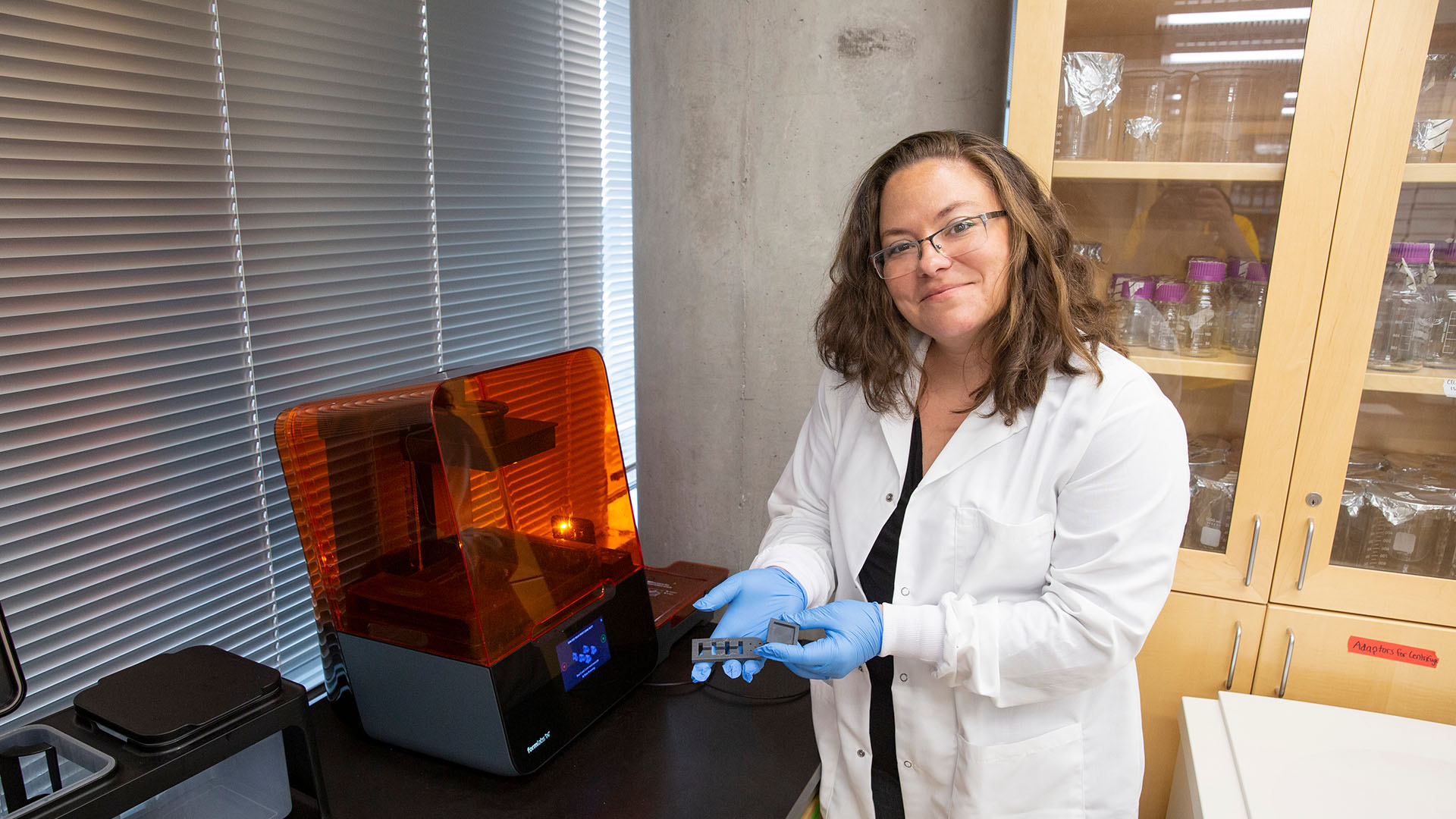
Jessica Weaver, an associate professor of biomedical engineering in the Ira A. Fulton Schools of Engineering at Arizona State University, holds a device in a lab. Weaver is one of many faculty members in the School of Biological and Health Systems Engineering, part of the Fulton Schools, translating academic research into market-ready innovations. Photo by Erika Gronek/ASU
January 06, 2026
By Emmanuelle Compton
The future of engineering-driven health innovation is currently unfolding at Arizona State University.
In the School of Biological and Health Systems Engineering, part of the Ira A. Fulton Schools of Engineering, a new generation of biomedical entrepreneurs is translating fundamental discoveries into technologies that improve human health.
Supported by ASU’s innovation ecosystem and the National Institutes of Health, here are three researchers that are bridging the gap between academic research and clinical application through startup ventures born right out of their labs.
Engineering immune protection

Jessica Weaver
Associate Professor Jessica Weaver is leading the way in cell therapy innovation through her startup ImmunoShield Therapeutics. The company is developing a hydrogel-based cell-encapsulation platform designed to protect transplanted therapeutic cells from immune system rejection.
ImmunoShield’s approach could transform both regenerative medicine and diabetes treatment.
Weaver explains that her company’s goal is to make cell-based therapies more accessible by reducing — or even eliminating — the need for long-term immunosuppression, combining biomaterials design with translational immunology to enable safer, longer-lasting treatments.
The company emerged directly from Weaver’s NIH-funded research at ASU, where her lab explores bioinspired materials for cell delivery and tissue regeneration. Fulton Schools biomedical engineering postdoctoral researcher Matthew Becker, a key contributor to translating Weaver’s concepts into scalable technologies for the market, notes that ImmunoShield grew naturally out of the lab’s work.
“At ASU, we have a culture that doesn’t just allow but encourages innovation,” Becker says. “ImmunoShield is an example of what happens when engineering and translational science come together.”
Weaver credits the School of Biological and Health Systems Engineering’s entrepreneurial support structure — from collaboration with ASU Skysong Innovations to the Fulton Schools’ Venture Devils program — for helping her lab navigate early-stage development and patenting.
“The infrastructure here really empowers faculty and trainees to think like innovators while staying grounded in rigorous science,” she says.
Patient-centered medical technologies

Brent Vernon
Associate Professor Brent Vernon, who has a joint appointment in the John Shufeldt School of Medicine and Medical Engineering, co-founded Sonoran Biosciences with Derek Overstreet, the company’s CEO and a Fulton Schools biomedical engineering doctoral alumnus, to develop new extended-release drug formulations.
Currently, Sonoran is focused on addressing the critical need for improved postoperative pain management. The company develops hydrogels that activate based on temperature and deliver a local anesthetic to surgical sites, with the long-term goal of managing pain at its source and reducing reliance on systemic medications, like opioids.
“We are excited by the potential to transform the postoperative recovery process by eliminating routine postoperative opioid prescriptions,” Overstreet says. “A major driver leading to the founding of Sonoran was an evening seminar hosted by ASU’s entrepreneurship group at the time. The emphasis of ASU and the School of Biological and Health Systems Engineering on supporting entrepreneurship has only increased since then.”
Vernon also co-founded Aneuvas Technologies Inc., or ATI, which is developing injectable liquid technologies to improve the safety and durability of minimally invasive vascular and neurovascular treatments for stroke.
ATI is led by Timothy Becker, the company’s chief technology officer. Becker, an ASU biomedical engineering doctoral alumnus and a professor of practice of mechanical engineering at Northern Arizona University, notes the influence of the School of Biological and Health Systems’ innovation environment.
“The School of Biological and Health Systems fosters a culture where innovation isn’t just encouraged — it’s expected,” he says. “The collaborative environment, access to clinical partners and openness to entrepreneurship helped shape ATI’s approach and my development as a medical technology leader.”
Both Sonoran Biosciences and Aneuvas Technologies have received NIH Small Business Innovation Research and Small Business Technology Transfer funding.
The Small Business Innovation Research program supports early-stage companies as they develop and validate new medical technologies, while the Small Business Technology Transfer program requires collaboration between a small business and a research institution — ensuring university discoveries have a clear pathway to real clinical use.
“Research only reaches its full impact when it improves people’s lives,” Vernon says. “ASU provided the environment, resources and partnerships to move these technologies from an idea in the lab to meaningful solutions for patients.”
Moving biosensing and plasmonic imaging technologies to market
While some faculty pursue entrepreneurship by founding new companies, others advance innovation through strategic partnerships with industry — leveraging established commercialization pathways to accelerate impact.

Shaopeng Weng
Associate Professor Shaopeng Wang, who has a joint appointment in the John Shufeldt School of Medicine and Medical Engineering, exemplifies this complementary model.
Working in collaboration with Biosensing Instrument, Wang translates advanced biosensing and plasmonic imaging technologies developed in his ASU lab into widely adopted analytical platforms used in drug discovery, antibody development and molecular diagnostics across academic and industry research settings worldwide.
Wang’s recent work centers on plasmonic scattering microscopy and single-molecule binding kinetics imaging, imaging technologies that enable researchers to quantify interactions and behaviors among various types of proteins at unprecedented spatial and temporal resolution. These platforms have been spotlighted in scientific news reports for making it possible to track hundreds of single molecules in real time and characterize complex binding interactions on living cells — capabilities that significantly advance therapeutic discovery workflows.
This translational effort is also supported by NIH Small Business Technology Transfer grants. Through these projects, Wang’s lab and Biosensing Instrument co-develop hardware, chemistry and data analysis methods while ensuring that core innovation remains integrated with student training and ongoing research in the School of Biological and Health Systems Engineering.
“Some technologies benefit from new company formation, while others advance more effectively through strong partnerships with established industry teams,” Wang says. “The School of Biological and Health Systems Engineering provides the flexibility to pursue the path that best moves the science toward real impact.”
An ecosystem for innovation
All three ventures — ImmunoShield Therapeutics, Sonoran Biosciences and Wang’s work with Biosensing Instrument — are only part of the biomedical entrepreneurship taking place in the Fulton Schools.
David Brafman, a Fulton Schools associate professor of biomedical engineering and the associate director of academic excellence in the School of Biological and Health Systems Engineering, emphasizes that the school trains engineers to be both scientists and entrepreneurs.
“Across our undergraduate and graduate programs, students work side by side with faculty to identify unmet needs, develop solutions and understand how those innovations move into real-world use,” Brafman says.
“From early design experiences through advanced research and capstone translation projects, our students are learning not only what to innovate but how to bring those ideas forward. It’s no surprise that many go on to launch ventures, lead translational research and drive new technologies in health and medicine.”
Why this research matters
Research is the invisible hand that powers America’s progress. It unlocks discoveries and creates opportunity. It develops new technologies and new ways of doing things.
Learn more about ASU discoveries that are contributing to changing the world and making America the world’s leading economic power at researchmatters.asu.edu.Learn more about ASU discoveries that are contributing to changing the world and making America the world’s leading economic power at researchmatters.asu.edu.
Attribution:
January 06, 2026
Author: Emmanuelle Compton, ASU News