
With 100,000+ visitors expected for the 71st annual event, the Valley Fever Center for Excellence will distribute 1,200 flyers to alert them to dangers of the fungal respiratory illness caused by inhaled spores found in soils of the U.S. Southwest.
The Valley Fever Center of Excellence is celebrating 30 years of impact
- A busy weekend lies ahead for the Valley Fever Center for Excellence’s John Galgiani, MD, who got the Tucson Gem & Mineral Show to distribute handouts on the respiratory illness, Feb. 12-15.
- On Monday, Feb. 16, which also is Presidents Day (George Washington’s birthday), Dr. Galgiani will be at the Arizona Legislature where he’ll be presented with a State Senate resolution acknowledging the center’s founding 30 years ago.
- Videos from the 30th Annual Farness Lecture and another Valley Fever Awareness Week lecture are now available at the Center’s website.
With well over 100,000 visitors descending on Tucson since Jan. 18 for the Tucson Gem, Mineral & Fossil Showcase, this weekend is the pièce de résistance — the international event’s flagship 71st Annual Tucson Gem & Mineral Show at the Tucson Convention Center, Feb. 12-15.
Attracting up to 65,000 people itself, the TCC event serves as the main attraction for the broader three-to-four-week citywide showcase drawing jewelers, gem cutters, mineral and fossil experts, and purveyors of Native American, African and Asian jewelry, art, crafts, décor, textiles, etc., as well as the buying public, of course, from around the globe. It’s the biggest such event in the world.
Tickets — $15, with children age 14 and under free with a paying adult — are required for this main venue. It runs 10 a.m. to 5 p.m., Thursday through Saturday, and 10 a.m. to 4 p.m. on Sunday. A $2-off coupon can be found at the Tucson Gem & Mineral Society website.
An opportunity to raise awareness
That said, all of those people visiting an area — the Old Pueblo (aka, Tucson), Arizona and U.S. Southwest — where a little known pathogenic fungus, Coccidioides posadasii, is endemic in soils and can cause a severe respiratory infection known as Valley fever if inhaled, made a University of Arizona center dedicated to research and raising awareness on the disease think that it might be an opportunity.
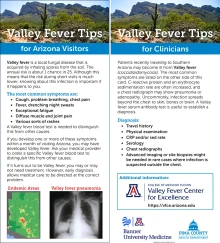
Both sides (front and back) of an informational handout developed by the University of Arizona Valley Fever Center for Excellence to be distributed to tourists to Tucson to alert them to the risks of the fungal respiratory disease caused by inhaling spores found in area soils.
U of A Valley Fever Center for Excellence
John N. Galgiani, MD, founding director of the Valley Fever Center for Excellence, has plotted since the fall about distributing an informational card for those Gem & Mineral Show visitors so they better understood the risks of Valley fever, also known as coccidioidomycosis or cocci, should they come down with it while here or after they return home.
The Division of Infectious Diseases professor at the U of A College of Medicine – Tucson and Phoenix reached out to the Tucson Gem & Mineral Society, which hosts the show, and it agreed to distribute the cards, which feature logos of the center and Banner – University Medicine. About 1,200 will be shared as handouts at the TCC event.
The 4” x 8.75” card features tips for visitors on one side and for clinicians on the other, underscoring that if flu or pneumonia-like symptoms persist, a fungal test ought to be given to rule out Valley fever. That’s because while antibiotics work on bacterial pneumonia, they don’t on Valley fever, which is caused by a fungus. And, while most people may suffer negligible symptoms, for a few, Valley fever can cause severe consequences, including death.
“A lot of people may spend time outdoors as they’re touring the Showcase’s various venues around Tucson or they may go for a desert or mountain hike or round of golf while they’re here,” Dr. Galgiani said. “We just want to make sure they’re aware of Valley fever and to get tested for it if persistent symptoms warrant that.”
Blue Sky Minerals’ Mike Hollonbeck, a Gem & Mineral Society past president, said it only made sense to agree to hand out the Valley fever awareness flyers at the Gem & Mineral Show.
“We’re glad the Valley Fever Center is doing this work of outreach and awareness building around Valley fever to make sure people take care of their health,” he said. “It’s good for visitors and Tucsonans, too.”
Dr. Galgiani said he’s grateful to the Society for supporting distribution of the handouts as part of an awareness campaign supported solely through donations to the Center via the U of A Foundation.
“The Gem & Mineral Society’s leadership immediately saw the value of passing on local information to their visitors. A great many come from across the world; and, for most, Valley fever would be an unknown problem for their doctors if they became ill after returning to their homes,” he added.
Three thousand handouts were printed with many of the balance planned for use at joint outreach efforts with Pima County Health later in the year. The Tucson Festival of Books already has agreed to do what the gem show is doing. Students from University High School have joined in the awareness effort. They hope to work with public health departments here and elsewhere to include Valley fever in a “desert health advisory” webpage that websites visited by visitors to Arizona can add as a link to give information to make their visit safer. Besides Valley fever, topics would include advice about managing heat, watching out for flash flooding and avoiding venomous desert dwellers.
30th anniversary recognition for VFCE

John N. Galgiani, MD, and Arizona Senate President Warren Petersen
Also this week, Dr. Galgiani was informed he should be at the Arizona Legislature at 1 p.m., Monday, Feb. 16, for a ceremony in which State Senate President Warren Petersen (R-Gilbert) will read a resolution approved in recognition of the three decades since the Center was established at the University of Arizona and subsequently approved by the Arizona Board of Regents — Feb. 16, 1996.
“I am very pleased that the Arizona Senate, with this resolution, is recognizing the major impact Valley fever has on Arizona as well as California and other parts of the Southwestern United States,” he said. “This is not just about public health, although thousands of Arizonans every year need medical attention for their Valley fever infections. It also has an enormous economic impact, costing Arizonans over $700 million each year. That’s approximately $100 per person per year.”
The Center also is pioneering more rapid testing for Valley fever so that clinicians can diagnose this problem before patients leave the clinic. And, looking ahead, the Center has developed a vaccine to protect dogs and humans. Its commercial partner, Anivive Lifesciences, is well along the way for a veterinary product and recently began work toward developing a human vaccine.
Valley fever lectures now online
In other news, recordings of two lectures given around Valley Fever Awareness Week 2025 this past November are now available to view.
Amy Hsu, PhD, was the presenter Nov. 21, 2025, at the 30th Annual Farness Lecture sponsored by the Valley Fever Center for Excellence and given as part of the Immunobiology Seminar Series hosted by Tucson college’s Department of Immunobiology. Her topic was “Infection, Genetics, and Immunology Lessons from Coccidioides.” A biologist with the National Institute of Allergy and Infectious Diseases (NIAID), Dr. Hsu works in the Immunopathogenesis Section at the Division of Intramural Research’s Laboratory of Clinical Immunology & Microbiology in Bethesda, Maryland.
Dr. Galgiani said of Dr. Hsu, “Amy is leading the field in understanding the immunogenetic causes of why some people develop the most severe complication of Valley fever — disseminated cocci. Knowing better why that is could lead to interventions for either prevention, diagnosis or even treatment.”
About a week earlier, Lisa Shubitz, DVM, a VFCE researcher and veterinarian, gave a virtual presentation to a large group of veterinarians on “Hard Facts and Heartache of Valley Fever in Dogs: Some science, stories and hope.”
These and other Valley fever presentations and reports (back to 2008) are archived en masse at the VFCE website here.
ALSO SEE:
“Athletes team up with the Valley Fever Center for Excellence” | Posted Sept. 9, 2025
“Dr. Fariba Donovan works to keep ‘The Last of Us’ in fictional realm” | Posted June 9, 2025
“Cocci Study Group discusses latest advances in Valley fever research in Phoenix” | Posted April 14, 2025
“Pursuit of Valley fever vaccine passes significant milestone” | Posted Aug. 6, 2024
“Leading Valley fever expert shares ‘state-of-the-art’ knowledge about fungal disease” | Posted Feb 15, 2024
“Dr. John Galgiani receives AZBio Pioneer Award for Life Achievement” | Posted Oct. 2, 2023